

Originally published Jun 20, 2025 | Updated August 2026
Editor’s Note: Since this article was first published in 2025, industry discussions around Silicon, GaN, and SiC have continued to evolve. This updated version expands on the original discussion with additional insights into advanced power architectures and next-generation silicon device innovation.
For more than a decade, the power semiconductor industry narrative has centered around the rise of wide-bandgap (WBG) materials such as gallium nitride (GaN) and silicon carbide (SiC). Their impact has been significant, particularly in high-voltage and ultra-high-frequency applications.
But the future of power electronics will not be defined by a single material. It will be defined by technology that delivers the best overall system outcome for a given application.
In that future, silicon remains one of the industry's most powerful innovation platforms. Built on decades of manufacturing maturity, deep engineering expertise, and a global ecosystem that represents more than 95% of semiconductor production infrastructure, silicon continues to enable advances in power device performance.
The Next Phase of Silicon Innovation
For decades, advances in silicon power devices have come through continuous refinements to established architectures by optimizing epitaxial layers, gate structures, and charge balance to improve performance.
As superjunction technology matured, those incremental gains naturally became smaller. The next leap forward required a different approach.
Rather than further refining conventional device structures, the next generation of silicon innovation comes from fundamentally rethinking device architecture. By redesigning how current conduction and voltage blocking are achieved within the device, new architectures can simultaneously improve conduction efficiency, switching performance, and ruggedness, capabilities that were once considered competing tradeoffs.
Reengineering Silicon with SuperQ® Technology
iDEAL Semiconductor has taken this approach in developing our SuperQ technology, introducing a fundamentally different silicon power device architecture designed to overcome traditional performance tradeoffs.
SuperQ utilizes a patented asymmetric, charge-balanced architecture engineered at the atomic level to dramatically improve current conduction while maintaining high blocking-voltage capability. The result is a device structure capable of simultaneously reducing conduction losses, lowering stored charge, and improving switching behavior.
Unlike conventional approaches that force engineers to trade one parameter against another, SuperQ technology is designed to break traditional silicon tradeoffs while leveraging the maturity and scalability of the silicon manufacturing ecosystem.
Performance Beyond On-Resistance
The SuperQ architecture can be applied across a wide range of power devices, including diodes, MOSFETs, IGBTs, and integrated power ICs. In these devices, the key parameter is resistance per unit area (Rsp), a measure used to assess a device's ability to deliver low on-resistance in a small package.
In silicon, SuperQ delivers lower Rsp than commercially available devices. In fact, it has been shown to deliver a 42% reduction in resistance compared to leading silicon devices available today and a 22% reduction compared to 200 V GaN solutions.
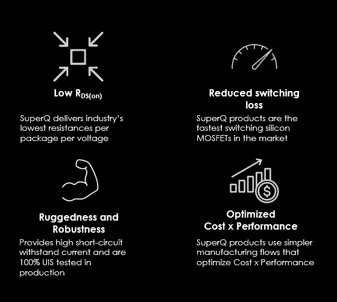
However, SuperQ is not simply optimized for low conduction loss. SuperQ devices exhibit ultra-low leakage current, store less energy, and have exhibited extreme ruggedness and robustness.
System-Level Performance by Design
Power semiconductor performance is no longer measured by a single device parameter. Engineers are increasingly evaluating technologies based on their impact on the entire power system, including efficiency, thermal performance, reliability, power density, implementation complexity, and overall cost.
SuperQ was engineered with this broader system perspective in mind. By simultaneously reducing conduction and switching losses while delivering exceptional ruggedness, SuperQ enables designers to improve efficiency without compromising robustness. Lower losses can reduce thermal stress, enabling smaller cooling solutions, fewer devices in parallel, and higher power density. Faster switching can reduce magnetic component size and improve overall converter performance, while enhanced short-circuit capability provides additional design margin in demanding applications.
Just as importantly, these improvements can be realized using familiar silicon design practices, standard gate-drive voltages, proven manufacturing processes, and established qualification methodologies. Engineers can achieve meaningful system-level gains while minimizing design disruption and accelerating time to market.
Reliability and Manufacturing
As power systems become increasingly critical to industrial infrastructure, transportation, AI computing, and automation, long-term reliability becomes even more important.
Because SuperQ devices are built on a silicon foundation, they benefit from decades of accumulated manufacturing experience and qualification knowledge across the global semiconductor ecosystem.
At iDEAL Semiconductor, qualification testing extends beyond standard JEDEC requirements to support the long-term reliability expectations of demanding industrial and automotive applications. This includes extended testing for HTRB, HTGB, temperature cycling, and IOL performance.
The Future of Power Electronics Is Not One Material
Power electronics is entering a multi-material era.
Advanced silicon technologies and WBG will each play important roles. The winners will not be determined by material alone but by the ability to deliver the best combination of efficiency, ruggedness, manufacturability, scalability, and cost-effectiveness.
Rather than reaching the end of its roadmap, silicon is entering an entirely new phase of innovation. Advanced architectures such as SuperQ demonstrate that meaningful gains in efficiency, ruggedness, and system performance remain possible using the world's most mature semiconductor platform.
The question is no longer whether silicon remains relevant. The question is how far next-generation silicon architectures can push the boundaries of power semiconductor performance.
Learn More About the Future of Silicon Power Devices
Watch the on-demand webinar featuring iDEAL’s CTO & co-founder, David Jauregui, discussing how next-generation silicon architectures are challenging conventional assumptions about power semiconductor performance.
Watch the webinar:
SemiX-IIT Bombay Webinar: Reengineering Silicon Power Devices
Evaluating SuperQ for Your Next Design?
Whether you are designing for AI power systems, robotics, industrial motor drives, battery-powered platforms, or high-density DC-DC conversion, the iDEAL Semiconductor applications team can help you evaluate where SuperQ devices can improve the efficiency, robustness, and overall performance of your next design.
Connect with an applications engineer:
Ask a SuperQ Expert