
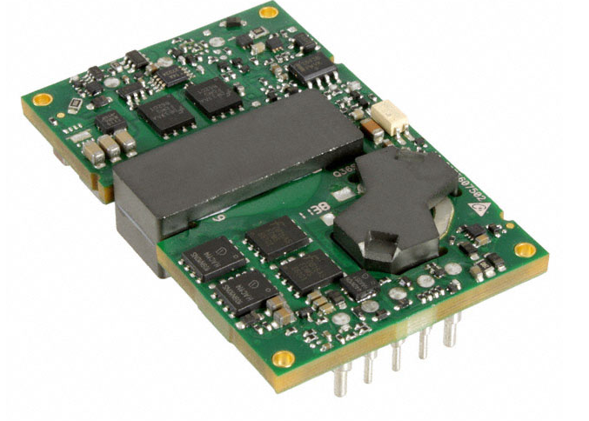
The quarter-brick DC/DC converter remains one of the most widely deployed isolated power modules in telecom infrastructure, networking equipment, industrial systems, and distributed 48V architectures.
Although the quarter-brick format is mature, incremental efficiency improvements still matter. At 200W power levels, a 1% efficiency gain equates to roughly 2W less heat. In densely populated telecom racks or data-center shelves containing dozens of modules, those watts add up, reducing cooling demand, improving reliability margin, and lowering operating cost.
Why Device Selection Matters at 270kHz
As switching frequencies rise to reduce magnetics size and improve transient response, MOSFET selection becomes increasingly critical. In lower-frequency converters, conduction loss (RDS(on)) often dominates. But at ~270kHz, common in modern active clamp forward designs, switching and capacitive losses play a much larger role.
To evaluate device impact, testing was conducted on a 200W quarter-brick converter operating at 270kHz in an active clamp forward topology. The default design used two 120V MOSFETs in parallel on the primary side. These were replaced with a single 150V MOSFET, including the SuperQ® device iS15M7R1S1C and representative modern 150V alternatives.
Measured Electrical and Thermal Results
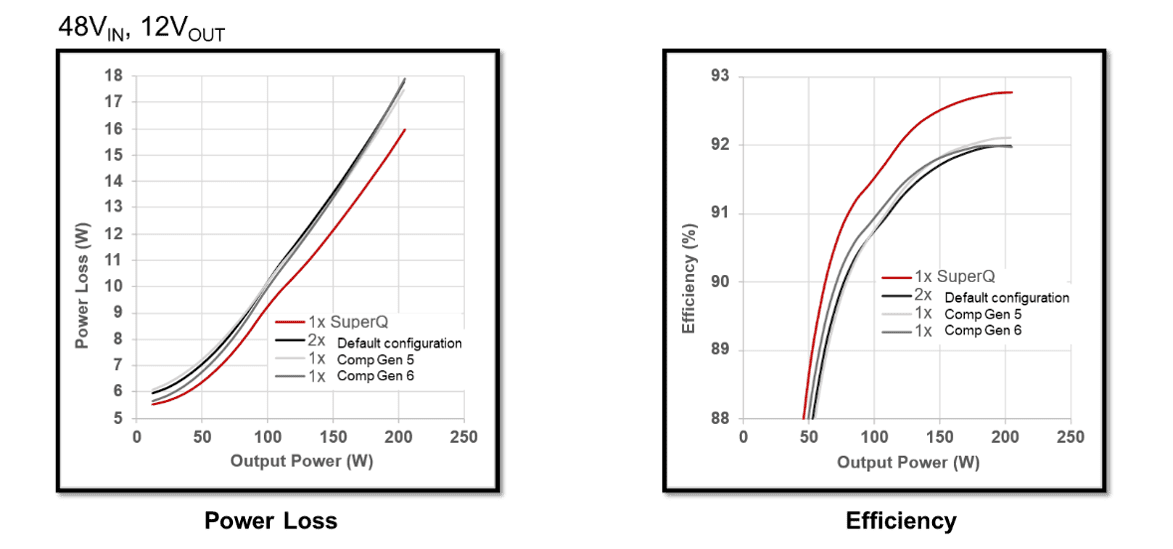
At 48V input and full load, replacing the dual 120V devices with a single 150V SuperQ MOSFET:
- Reduced total power loss by up to 2W
- Improved overall efficiency by more than 0.8%
- Reduced peak temperature by ~31°C
In a 200W converter, a 0.8% improvement is not incremental; it directly reduces thermal stress and increases system margin. A 30°C+ junction temperature reduction significantly improves long-term reliability, enables higher ambient operation, and reduces airflow requirements.
Fewer Devices, Lower Stress
An additional benefit emerged: device consolidation.
The original design required two 120V MOSFETs in parallel to meet conduction and thermal constraints. The 150V SuperQ device achieved lower total loss and lower peak temperature with a single device.
Reducing the device count simplifies the layout, lowers gate-drive current, mitigates current-sharing imbalances, and can reduce the bill-of-materials cost. In high-volume quarter-brick production, component consolidation meaningfully impacts cost and manufacturability.
Conclusion
Even in mature power formats like the quarter-brick, device innovation still unlocks measurable gains. As system power density continues increasing, incremental device-level efficiency improvements remain one of the most practical and scalable levers available to power designers.
Ready to Improve Your Converter Performance?
The 150V SuperQ MOSFET demonstrates that balancing RDS(on), switching charge, and stored energy can deliver measurable improvements in real-world systems, including lower loss, reduced junction temperature, and simplified primary-side implementation.
For more details on this design, read the full article in Bodo’s Power Systems: Bodo’s Power Systems – Improving Efficiency and Thermal Margin in a 204W Quarter-Brick Converter Using a 150V MOSFET
Interested in evaluating SuperQ in your isolated DC-DC converter?
- Connect with our applications team to review your topology: [email protected]