
Reliability in power semiconductors is often discussed in terms of qualification checklists and standardized stress tests. Passing industry benchmarks such as JEDEC qualification is a necessary step, but it is not, on its own, a complete indicator of how a device will perform in the field. Real-world systems, whether in motor drives, battery management, or power conversion, operate under dynamic, often harsh conditions that extend well beyond standardized assumptions. For engineers designing these systems, confidence in device reliability must come not only from compliance, but from demonstrated robustness under conditions that reflect actual use.
SuperQ® power MOSFETs are built on a silicon foundation, which brings well-understood physics and known failure mechanisms. Unlike newer materials, where long-term degradation modes may still be emerging, silicon has decades of field history. Mechanisms such as hot-carrier injection, bias-temperature instability, and dielectric wear-out are not only characterized but also deeply modeled and predictable. This knowledge base enables more accurate lifetime estimation and derating strategies, which are critical for system-level reliability design.
However, inherent material understanding is only part of the story. The architecture and process innovations behind SuperQ extend silicon performance while maintaining this predictability. These devices are designed to push beyond traditional silicon limitations in switching performance and conduction efficiency, but without introducing the complexity or uncertainty that can accompany alternative technologies.
To validate this in practice, iDEAL Semiconductor has taken a deliberate approach: testing well beyond standard qualification requirements. JEDEC qualification provides a baseline, defining stress conditions such as High Temperature Reverse Bias (HTRB), High Temperature Gate Bias (HTGB), Temperature Cycling, and Intermittent Operating Life (IOL). These tests are essential for identifying early-life failures and ensuring process stability. However, they are typically executed at defined durations and sample sizes that represent a minimum threshold for qualification. iDEAL’s “Beyond JEDEC” approach focuses on extending standard stress conditions to build a measurable reliability margin, rather than simply meeting minimum qualification thresholds.
SuperQ devices are subjected to extended stress durations and expanded validation conditions that exceed these baselines, as shown in Figure 1. For example, key stress tests such as HTRB and HTGB are conducted for durations up to four times the JEDEC standard requirements. Temperature cycling and IOL testing are similarly extended, providing additional confidence in the device’s ability to withstand thermal and electrical stress over time.
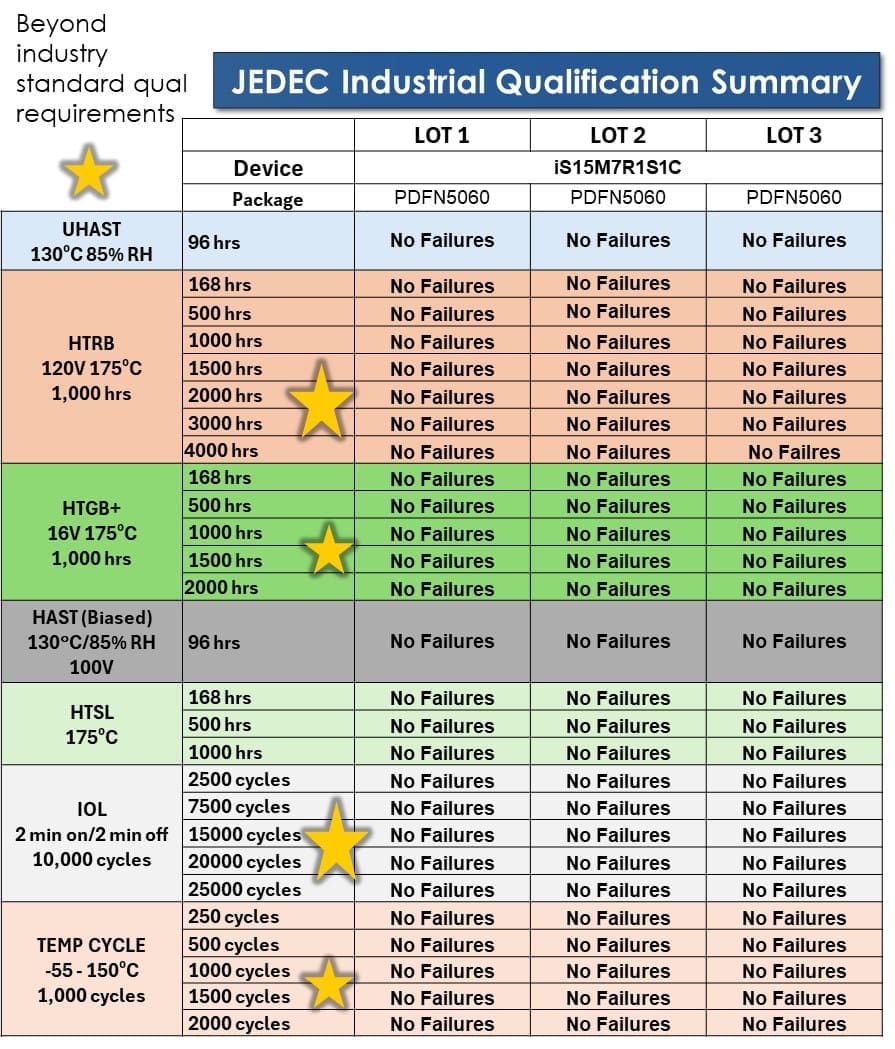
Figure 1: SuperQ devices are qualified well beyond standard JEDEC requirements, with key stress tests extended to 2×–3× standard durations. Across all major stress categories, including HTRB, HTGB, IOL, and temperature cycling, no failures were observed, reinforcing both device robustness and process consistency.
The results are consistent across multiple lots and devices: no failures observed under prolonged stress conditions. This consistency is particularly important. By demonstrating uniform performance across multiple production lots, SuperQ devices reinforce confidence not only in the design, but in the manufacturability and process control behind it.
Another important dimension is operating temperature. SuperQ devices are qualified to an industrial rating of 175 °C, reflecting the realities of modern power systems, where thermal constraints are increasingly challenging. Higher allowable junction temperatures provide designers with additional flexibility, whether that means reducing cooling requirements, shrinking system size, or handling transient overload conditions. Importantly, qualification at elevated temperatures also accelerates wear-out mechanisms, meaning that passing these tests provides a stronger indication of long-term reliability.

In addition to JEDEC, SuperQ devices have also achieved AEC-Q101 automotive qualification. Unlike many industrial qualification programs that use derated stress conditions, automotive qualification requires testing at the device’s full rated operating limits. For example, the iS20M028S1CQ was subjected to HTRB testing at 175°C with 100% of the rated drain-source voltage applied for 1,000 hours and to HTGB testing at 175°C with ±100% of the rated gate voltage applied for 1,000 hours. As shown in Figure 2, no failures were observed. This demonstrates that SuperQ devices not only exceed industrial qualification durations but also satisfy the more stringent stress conditions required for automotive applications.

Figure 2: Automotive-grade qualification of the iS20M028S1CQ demonstrates successful operation under AEC-Q101 stress conditions, including 100% rated-voltage HTRB and HTGB testing at 175°C with zero failures observed.
It is worth noting that automotive qualification is not limited to automotive applications. Increasingly, aerospace and defense, industrial, and energy systems are adopting similar expectations for reliability and robustness. Applications such as robotics, solar inverters, and battery-powered systems often operate in environments that rival or exceed automotive stress conditions. In this context, the AEC-Q101 qualification serves as a broader indicator of device robustness and quality.
While extended qualification data is critical, reliability ultimately manifests in how devices behave under real operating conditions. One of the advantages of SuperQ’s silicon-based architecture is its combination of robust safe operating area (SOA), strong short-circuit withstand capability (SCWC), and predictable thermal behavior. These characteristics enable the device to tolerate real-world electrical stress conditions and transient events, such as inrush currents, load steps, or fault conditions, that extend well beyond steady-state operation, reinforcing the robustness and ruggedness margin established through extended qualification testing.
Another often overlooked aspect of reliability is simplicity. Technologies that require specialized gate drive schemes, tight voltage margins, or complex layout considerations can introduce new failure modes at the system level. SuperQ devices avoid this “design tax” by maintaining compatibility with conventional silicon drive methods. Standard gate voltages, familiar design practices, and well-understood behaviors reduce the risk of unintended stress conditions, further enhancing overall system reliability.
Reliability is a combination of material properties, device architecture, process control, and validation. With SuperQ, iDEAL Semiconductor has taken a holistic approach. By leveraging the known reliability foundation of silicon, extending performance through innovative design, and validating devices beyond industry standards, the result is a platform that delivers both performance and confidence.
For engineers, this means fewer unknowns, greater design margin, and a clearer path from concept to deployment. In a design environment where power density is increasing and system demands are intensifying, reliability cannot be assumed. It must be demonstrated.
Evaluate SuperQ reliability in your design
If your application demands both high performance and proven robustness, SuperQ power MOSFETs offer a compelling path forward without the uncertainty or complexity of alternative technologies.
👉 Connect with our applications team to review your design requirements, discuss reliability considerations, or request evaluation support.