

For decades, power electronics designers have worked within the same fundamental constraints: improving conduction losses often comes at the expense of switching performance and vice versa.
But what if that tradeoff no longer applied?
In a recent technical webinar, hosted by SemiX – Center for Semiconductor Technologies at IIT Bombay, “Reengineering Silicon Power Devices,” iDEAL Semiconductor CTO and co-founder David Jauregui explores how a new approach to silicon device architecture is challenging long-standing assumptions about what’s possible with power MOSFETs.
The Problem with Conventional Silicon
Silicon power devices have evolved significantly from early HEXFET structures to superjunction technologies, but the underlying limitations remain. Improvements in on-resistance (RDS(on)) have historically come at the expense of switching performance, capacitance, and overall efficiency.
At higher switching frequencies, these tradeoffs become even more pronounced, limiting power density and increasing thermal challenges in real-world systems.
A Different Approach to Device Design
Rather than abandoning silicon altogether, iDEAL Semiconductor has taken a different path: fundamentally reengineering how silicon devices are built.
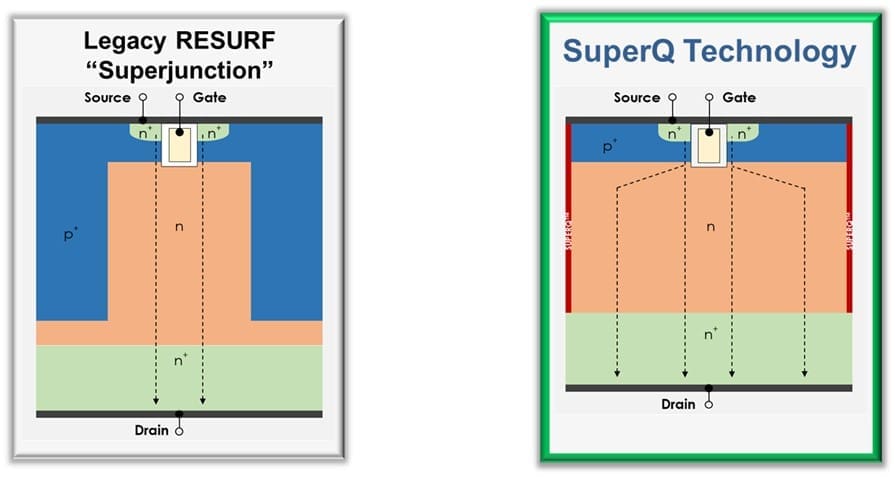
SuperQ® technology introduces an asymmetrical structure that maximizes conduction area, up to 95%, compared to the 50% in traditional RESURF-based designs.
This architectural shift enables:
- Lower RDS(on)
- Reduced switching losses
- Improved voltage blocking capability
- Simplified manufacturing with better cost-performance optimization
The result is a new class of silicon MOSFETs that challenges the assumption that wide-bandgap materials are the only path forward to higher performance.
Understanding Switching Losses: The Role of QSW and EOSS
A key focus of the webinar is switching loss and its direct impact on system efficiency.
Switching energy is closely tied to switching charge (QSW), which represents the time required for a MOSFET to transition between states. By reducing QSW, designers can significantly lower switching losses and operate at higher frequencies.
Similarly, output capacitance-related losses (EOSS) play a critical role, particularly at higher voltages and frequencies. SuperQ devices exhibit a slower increase in EOSS with voltage, thereby improving efficiency under real-world operating conditions.
From Theory to Real-World Performance
The webinar goes beyond theory, presenting measured results from a 375W boost converter operating at 300kHz.
In these tests SuperQ devices demonstrated lower total power loss compared to both silicon and GaN alternatives.
These results highlight an important point: system-level performance, not just device-level metrics, ultimately determines real-world success.

Reliability and Ruggedness Matter
Performance alone isn’t enough for modern power systems. Reliability and robustness are equally critical, especially in applications like automotive, industrial, and energy systems.
SuperQ devices have demonstrated:
- Zero failures across extended JEDEC and beyond-JEDEC stress testing
- High short-circuit withstand capability (up to 1.4× higher than comparable devices)
- Strong thermal and cycling performance under demanding conditions
This combination of efficiency and robustness enables designers to push performance boundaries without sacrificing reliability.
Rethinking What’s Possible with Silicon
The key takeaway from this session is clear….Silicon is far from done.
By rethinking device architecture, it’s possible to improve both conduction and switching performance, while maintaining cost advantages and delivering real-world reliability.
For engineers designing next-generation power systems, this opens up new possibilities
▶️ Watch the Full Webinar
This blog only scratches the surface.
The full webinar includes a detailed Q&A session in which real-world design questions are addressed, covering topics such as comparisons with wide-bandgap, reliability, and practical implementation considerations.
Watch “Reengineering Silicon Power Devices” on our YouTube channel
Request a copy of the presentation slides
Have a design challenge? Let’s talk.
If you’re evaluating device options or looking to optimize your next design: