
The rapid shift toward high-voltage battery platforms – 72V – 144V – is transforming e-mobility, power tools, drones, and other high-power applications. Higher voltage enables greater power delivery with lower current, reducing I²R losses, minimizing heat, and allowing designers to build lighter, more efficient systems. But as voltage increases, so does the need for robust, reliable protection circuitry. In these architectures, no component is more critical than the Discharge MOSFET.
Why the Discharge MOSFET Matters
When an external short circuit occurs, fault currents can surge into the thousands of amperes in microseconds. Only the Discharge MOSFET can stop this event, as shown in the example BMS diagram in Figure 1. If it fails to block the short, the battery enters uncontrolled current flow—a direct path toward thermal runaway. This makes Short-Circuit Withstand Capability (SCWC) the single most important safety metric for MOSFET selection.

Figure 1: Example battery management system with discharge and charge MOSFETs
SuperQ® Breaks the Traditional MOSFET Trade-Off
Conventional MOSFETs force designers to compromise between low RDS(on) and rugged short-circuit performance—but SuperQ eliminates this trade-off. In comparative testing of 150V, 2.5mΩ MOSFETs in the TOLL package, the SuperQ device sustained a peak short-circuit current of 641A, compared to 612A for a competing device with similar ratings, representing a 29A improvement in SCWC. This positions SuperQ as the top performer in both short-circuit robustness and conduction efficiency.
What Makes SuperQ Different
The technology advantage comes from structural innovations inside the silicon:
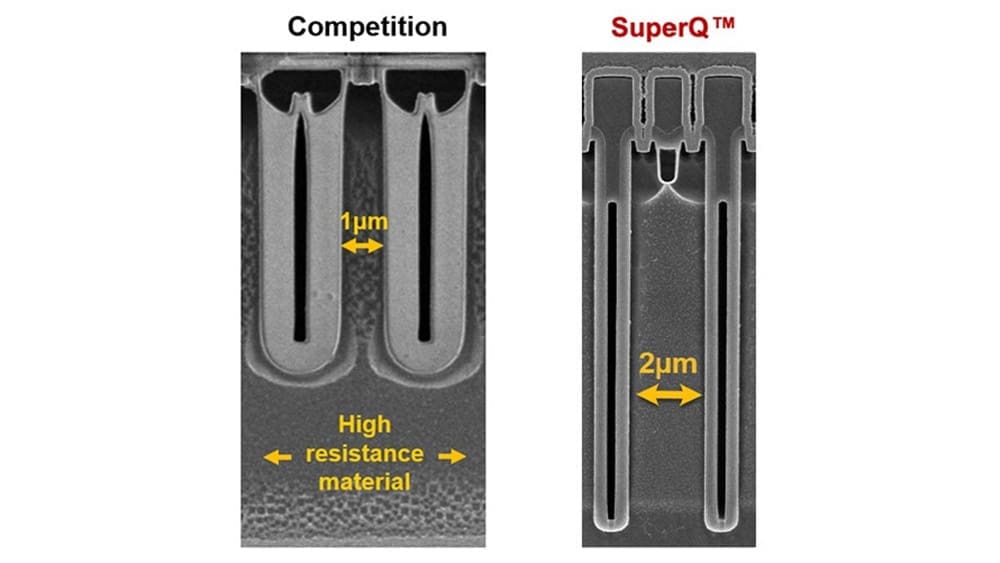
- Wide 2 µm mesa and wide metal contacts for stronger current density and higher robustness. Figure 5 illustrates the wider conduction region compared to competing 1µm mesa designs.
- Fully charge-balanced, asymmetrical trench architecture delivering ultra-low RDS(on) without sacrificing durability
- Superior thermal and avalanche behavior, ideal for punishing fault conditions

Figure 2: MOSFET unit cells showing gen-to-gen mesa width reduction (left) for competition vs. wide mesa design for SuperQ (right)
Real System-Level Benefits
In a typical 80V, 10Ah battery pack, SuperQ’s advantages translate to measurable savings.
- Up to 50% fewer MOSFETs required (2–3 vs. 4–5)
- Up to 50% lower solution cost
- Up to 42% lower RDS(on) for reduced heat and increased runtime
This allows designers to shrink system size, simplify thermal management, and improve reliability while lowering total BOM cost.
A Scalable Platform for High-Voltage Designs
SuperQ MOSFETs span 150V to 300V, covering the full range of high-voltage battery platforms—from 72V mobility systems to 144V industrial packs. Whether you’re developing scooters, mini-EVs, commercial tools, or autonomous robotics, SuperQ provides a higher safety margin and a more efficient power path.
Conclusion
High-voltage battery systems demand a discharge MOSFET that can survive extreme fault conditions without compromising performance or cost. SuperQ delivers industry-leading SCWC, ultra-low RDS(on), and meaningful system-level benefits—setting a new standard for safe, scalable, and cost-optimized BMS design.
Download the Full White Paper
Want the complete data, test methodology, device comparison charts, and technical deep dive? Download the full SuperQ Battery Management White Paper
Learn how to design safer, more efficient high-voltage battery systems using SuperQ technology.