
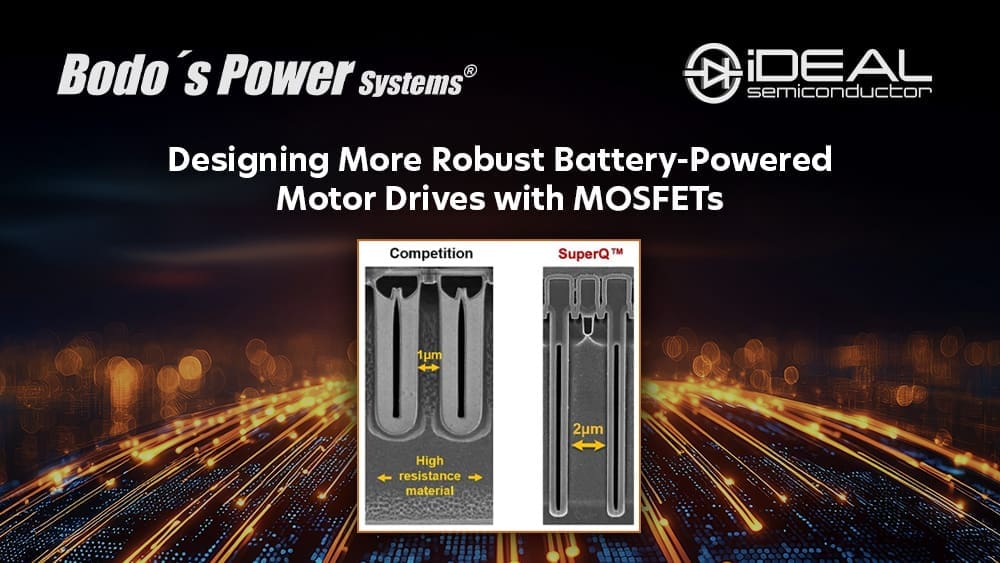
Battery-powered motor drives are becoming the dominant architecture across a wide range of applications, from micromobility and power tools to agricultural machinery and industrial electrification. As system power levels increase and battery voltages climb from legacy 48V architectures toward 72V, 96V, and even 144V platforms, designers face tradeoffs between efficiency, robustness, size, and cost.
SuperQ MOSFET robustness is not achieved through conservative derating or oversized packaging. Instead, it is built directly into the SuperQ architecture silicon architecture. The SuperQ structure employs a fully charge balanced trench design that preserves a wider conduction region than competing approaches that aggressively scale feature sizes to minimize resistance.